Jack Young was a true speedway hero during the 1950s, popular with the fans, especially in Scotland, and also popular with his teamates and rivals. He has also gone down in folklore as the only Second Division rider to win the World Championship, but he should be remembered for much more than that, he should also be remebered as a great speedway rider who never let success go to his head.
Jack Ellis Young first rode speedway in 1947 after his elder brother Wally had given him his bike. Wally had been a promising rider himself until he was forced to hang up his boots through ill health The bike was actually a stripped down road bike and Jack spent most of his first season in a special class for stripped down road bikes at his local Kilburn Club alongside another of his brothers, Frank. However it was not long before Jack's enormous natural talent was noticed and he started to gain sponsorship, notably from Fred Jolly who gave him the use opf an unusual AJW machine in 1950. The AJW was named after it's founder, Arthur John Wheaton and used a 500cc J.A.P. speedway engine.
+Speedfox+by+his+sponsor+Fred+Jolly+in+1950.+The+AJW+used+a+JAP+engine,.jpg) |
| Jack recieves a brand new AJW "Speedfox" from his sponsor Fred Jolly |
British clubs were allerted of this enormously talented young rider and started to show interest but Jack hesitated as he was still not sure if he had what it takes to succeed in British speedway. Eventually, another Aussie rider, Clem Mitchell phoned him with an offer to join him at second division Edinburgh for the 1949 season, an offer that he accepted. Ironically, he recieved a written offer from a new second division club at Walthamstow a few days later and Jack later admitted that if Walthamstow had contacted him earlier he probably would have gone there instead. The London clubs loss was definitely the Scottish clubs gain. He took 18 wins from his first 18 starts and eventually finished the season as the Monarchs second highest scorer and made his International debut too
Jack continued his superb form for Edinburgh in 1950, setting himself up for his first World Championship Final at Wembley where he finished with a credible 7 points. He admitted that the pace was a bit too hot for him, but racing against world-class competition was honing his talent.
Fast-forward a year to the 1951 World Championship Final. Pre-meeting favourite Jackie Biggs had collected 4 wins from his first four rides and only needed a point from his last race to take the title, but to the shock of the massive crowd he trailed in last and faced a run-off with Jack Young and Split Waterman for the title. Jack kept his cool and came to the tapes full of confidence that the title was his for the taking. Biggs made the start but Jack Young was right with him and soon forced his way through, followed by Split Waterman. Thus the man from the Second Division became the 1951 World Individual Speedway Champion. Such was his popularity that on his return to Adelaide it is reported that over 10,000 fans turned out to welcome him home.
1951 had been an outstanding season for Jack who had ridden in 39 league and cup matches for Edinburgh and dropped just 9 points. but when Aub Lawson left West Ham it was time for Jack to move up to Division 1 for 1952. His incredible form continued in the higher division with 19 maximums from 38 league matches, a successful run in the British Match Race Championships and a brilliant second World Title, leaving no doubt that he was the best and most consistent rider in the world at that time.
Jack came 4th in the 1953 World Final after inexplicably finishing last in his final ride. Engine problems may well have been the cause of this, but he bounced back in 1954 with a win in the London Riders Championship and was the top point scorer in the qualifying rounds for the World Championship but that years World Final heralded the beginning of a new era. The Trophy was won by a 21 year old genius from New Zealand named Ronnie Moore. The riders in that World Final also included Barry Briggs, Peter Craven, and Ove Fundin, four riders who would dominate the sport for years to come. Just as Jack Young had swept the old guard aside a few years earlier, he now had to play a supporting role to the younger men.
As far as Jack was concerned, speedway was not the be-all and end-all of life. He was a family man who liked to enjoy life's simple pleasures. He never won an Australian National Championship because he preferred to go fishing rather than spend days travelling across Australia. For all his brilliance on the track he remained a typical laid-back South Australian, at heart just an ordinary bloke who never assumed any airs and graces as World Champion. He was also a keen cyclist and often performed tricks on his bicycle and it was so typical of the man that after he retired it was reported that he took a job in an Adelaide brickyard and was using one of his his World Championship Trophies as a storage jar for his fishing weights!
When West Ham closed at the end of the 1955 season Jack Returned to Australia for a couple of years, returning to the UK to ride for Coventry in 1958 and then again in 1960 and 1961. He was still a class act, but now in the twilight years of his career he was finishing mid-field in World finals rather than on the podium. Nevertheless, he still scored more than 1000 points in his three seasons at Coventry.
 |
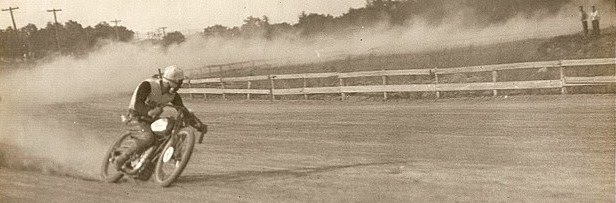
| Jack Young in action "Down Under" |
During his last season in England, 1961, he was able to work the old magic one last time when he won the Tom Farndon Trophy at New Cross, beating a top class international field. After two more years racing in Australia he announced his retirement in December 1963. Jack died of a lung disorder on 28th August 1987 aged 62. It had been a remarkable life. From humble beginnings he had risen to become the most outstanding speedway racer of his generation and one of the top three Australian riders of all time. His name is still revered by older fans in Edinburgh and he has a street named after him in West Ham.
 |
| Jack Young with the 1952 World Championship Trophy |
 |
| The J.A.P machine that took Jack Young to the 1951 World Individual Speedway Championship at Wembley. |


+Speedfox+by+his+sponsor+Fred+Jolly+in+1950.+The+AJW+used+a+JAP+engine,.jpg)


