Monday, 26 April 2010

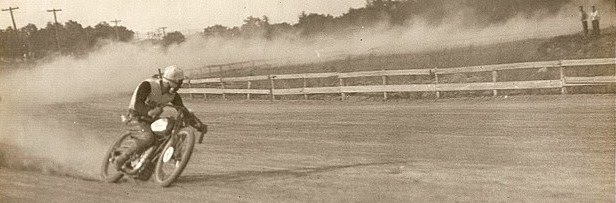
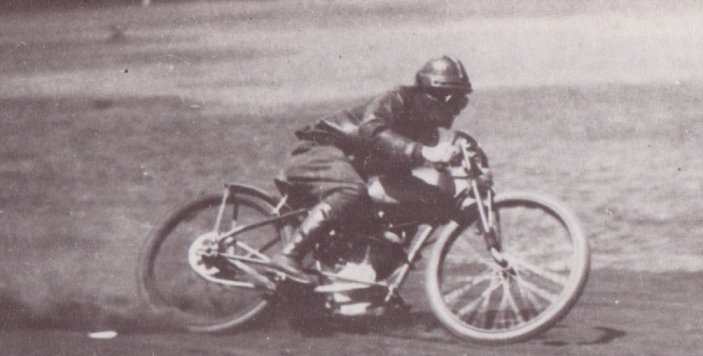
HARLEY-DAVIDSON - "PEASHOOTER"

No brakes, no gears, no problem! The Harley-Davidson “Peashooter” was a full-on racing machine. Anything that didn’t help it go faster was just dead weight that was removed in a quest for victory.
Introduced in 1926, the 350cc singles were Milwaukee's response to Indian's Prince of the same displacement. They came in two variants, an economical side-valve for general lightweight transportation, or the more ferocious over-head-valve version. Known as the 'Peashooter' because of its staccato exhaust note, the 350cc roadster engine produced 8 horsepower, while the OHV racing version produced 12 horsepower and came equipped with a magneto.
The racer gained its performance advantage thanks to special combustion chambers designed by British engineer Harry Ricardo. A design feature called a 'squish band' created turbulence in the fuel charge, resulting in a fuller burn and thereby greater horsepower. In addition, the competition Peashooter engine also featured pressure oil feed to most of the bearings and had a sodium-cooled exhaust valve. It also featured a shorter wheelbase than the roadster and weighing only 215lbs, the racing "Peashooter" possessed an excellent power-to-weight ratio too.
Although introduced in the mid-1920s, the Peashooter's heyday was the early 1930s. By this time virtually all the expensive-to-maintain banked wooden board tracks closed and the focus of American motorcycle sport shifted back towards flat-track racing where the 350cc Harley excelled in the 21' cubic inch "Class A" . Flat track racing had started in the early 1900s on half-mile and mile-long horse tracks which were loosely  surfaced, hence the alternative name of "dirt-track" racing. The "Peashooter was also exported and proved its worth on the speedway circuits of Australia and Europe.
Harley-Davidson factory rider Joe Petrali
By the mid-1930s the focus of American racing had switched to the production-based "Class C" machines and the British J.A.P. engine had replaced virtually everything in the speedway world... The "Peashooter's" day had passed.

Sunday, 25 April 2010

CYCLONE- 1913-1916.

The Cyclone is probably one of the most purposeful bikes of all time and was certainly way ahead of its time in terms of engine build and performance. The bike was built by Joerns Motor Manufacturing Company of St Paul, Minnesota, USA, which itself grew out of the Thiem Manufacturing Company, an engine builder which operated from 1903 to 1911. Board-track and dirt-track motorcycle racing were big money earners in America during the early 20th century with Indian and Harley-Davidson leading the way and then Cyclone came onto the scene in 1912 with their 1000cc, over-head cam v-twin.
The bevel drive ohc engine was designed by Swedish engineer, Andrew Strand, and was possibly the most powerful motorcycle engine of the day. The motors ran very well and were very strong but the frame was really nothing more than a modified bicycle frame with an unpadded leather saddle and even bicycle pedals.
While racing a Cyclone in 1914, development engineer J.A.McNeil set a new speed record of 111 mph, beating the Excelsior of Lee Hummiston at 100mph (yes this was 1914!). The quality of the workmanship was very high in most regards, as the motors were machined to very high accuracy. Ultimately, the motors and the bikes were not as reliable as more conventional designs. Some races were lost due to mundane issues like cracked fuel tanks or broken chains, but some were lost due to exhaust valve and piston breakages.
J.A.McNeil on a Cyclone
Racing is what Cyclones did best, and the name most closely associated with them after that of designer Andrew Strand is Don Johns, perhaps the most successful of all Cyclone riders. In a 1941 magazine interview, Johns recalled some things about the legendary Cyclone... "The yellow rig attracted a great deal of attention wherever I raced it. It used special Swedish precision bearings and was very light and very powerful. The motor was so powerful that I would wear out a set of tires in just a few laps. I switched from U.S. Tires to a newly designed Goodyear and that helped. It was the first racer to turn over 5000 rpms. It had a unique sound and was often five to seven miles per hour faster than the other factory rigs."
Don Johns on his Cyclone
One legendary victory for Johns on the Cyclone was a winner-take-all one-lap race around a mile dirt track in Phoenix on November 18, 1913. The promoter offered the princely sum of $1000 to the vehicle that could lap the mile the fastest – that included planes flying just above the mile oval. Johns and the Cyclone beat the automobile ace Barney Oldfield and barnstorming pilot Lincoln Beachly to win the prize.
The Cyclone, while often the fastest motorcycle at a race, suffered from reliability problems. Johns easily turned the fastest lap times and many times built big leads only to suffer mechanical problems with the bike. The most infamous race for Johns and Cyclone was the epic 1915 Dodge City 300. A total of seven manufacturers fielded factory teams in the event. Harley-Davidson, debuting in the classic race, and Indian each had eight riders. Johns, on the Cyclone, turned laps over two mph faster than Dave Kinney’s qualifying speed in the early laps and was heavily favoured to win the race. He opened a large lead, lapping a number of riders in the first fifty miles. Then the bike began to fade and he lost the lead just before the 100-mile mark and later dropped out of the running. Johns also lead similarly in the 100-mile national at Ascot Park until the Cyclone again failed before reaching the chequered flag. Johns did win a number of shorter races on the Cyclone, including the 1 mile FAM National held in Sacramento in July of 1915.
The company owners of Cyclone had little experience or even interest in marketing, building up dealerships or service, production was slow and expensive, profits were minimal, so the owners eventually stopped production in 1915 after no more than 300 Cyclones had been built. A number of ttempts were made to revive the Cyclone. Firstly, in 1916, a Chicago businessman bought the assets and moved the machinery, partially completed bikes and all the remaining parts to Chicago, where they were stored in a warehouse. Two other investors got involved, but were unable to get the business up and running. Four years later, the left-overs were sold and moved to Cheboygan, Michigan, where a building was put up and production was set to resume. This never happened either and another move to Benton Harbor, Michigan was made. Another factory was prepared and Andrew Strand was brought in to update the design. A new Cyclone with a three-speed transmission (reportedly based on an Excelsior unit) was displayed and adverts appeared in motorcycling magazines. Again, nothing came of it. The Cyclone's last gasp came in 1923. A racer called the Reading-Standard competed in several races. As it turned out, this was a Cyclone bearing a different name on its tank. Reading-Standard (itself recently purchased by the Cleveland Motor Company), had acquired all remaining Cyclone assets and put together one last racer from left-over parts.
A painting of a 1916 Cyclone by Don Bradley

Engine: 45degree OHC V-Twin 
Capacity: 1000cc
Horsepower: 45bhp
Wheelbase: 53" (135cm)
Weight: 260lbs (118kg)
Top Speed: 110mph (177kph)
Cost: $350

Saturday, 24 April 2010

HARLEY-DAVIDSON CAC SPEEDWAY MODEL - 1934

The Harley-Davidson CAC 500cc single port speedway model is very rare and not much is really known about its history. One came up for auction in Las Vegas a few years ago and the owner talked about it to Rick Newlee. It appears that there were 12 of these machines built, the whereabouts of 9 of them is known but nobody is sure what happened to the other 3. It appears that H-D factory rider Joe Petrali was the man instrumental in getting these machines built. Joe had more or less begged Harley-Davidson to build the bikes, but they were not really interested. Joe hung around the H-D plant and pestered them until they gave in to Joe's wishes on the condition that he built it himself (or hired his own people). Other conditions were that he could only use the plant on weekends and he must leave the workshop in good clean order come Monday. He also had to put the Harley-Davidson name on the bike (just in case it became a success!). After a few of the CAC machines were built and tested, Joe tried to persuade Harley-Davidson to put the CAC machines into production for a second time, however the tests did not go as well as expected and the engines didn't make the power he had hoped for. It appears that Joe had copied the British J.A.P. engines to some degree, but had a problem with the cams and the cam timing. Harley-Davidson decided not to get involved and the project ended.

Joe Petrali, also known as "Smokin' Joe" to others, left a huge mark in the world of motorcycles. His career in motorcycles spanned from the mid 20s on into the mid to late 30s riding in everything from board track races, dirt track races, land speed records and hillclimbs. Joe is part of the AMA motorcycle Hall of Fame and a full account of his successes are available to read here

Joe Petrali on his factory Harley-Davidson racer in 1925

UPDATE>>>
I recently found this publicity photograph of Walter Davidson sitting on a CAC at the model launch.

Friday, 23 April 2010

CROCKER SPEEDWAY BIKES 1931-34

Interest in European-style speedway had exploded in the USA after its introduction by Lloyd "Sprouts" Elder during 1931. Several high school sports fields in the Los Angeles area had been turned into speedway tracks during the summer vacation. Local Indian dealer, Albert "Al" Crocker was fascinated with this new sport, so, in partnership with his chief engineer Paul Bigsby, they decided to build their own speedway bike. The initial 1931 prototype was a special Crocker frame into which they installed a regular 45 cubic inch (750cc) sidevalve Indian 101 Scout engine. Satisfied with this frame design, Crocker next turned his attention to a better engine, so for the 1932 campaign several Scout engines were converted into 30.50 cubic inch (500 cc) overhead valve units.
1931 OHV Crocker Indian V-Twin
The first of the Crocker-powered overhead valve singles appeared at Emoryville Speedway in California in November 1933. Cordy Milne rode the machine in twelve races and took nine first places and one second place during the meetings held on November 11th and 14th. His brother Jack had four first places during the same two meetings. Other top riders who used the first Crocker dirt trackers were Miny Waln, Earl Farrand and Snooky Owens, so the marque was well represented.

Unfortunately for Al Crocker, the British J.A.P. powered bikes were beginning to dominate speedway in Europe and were rapidly replacing the Douglas and Rudge machines which had dominated the sport since 1928. The 40hp Crocker proved itself the equal of the Rudge, and was superior to the Harley-Davidson CAC. However, the J.A.P. machines were good for 42-43 hp, so Crocker's new baby needed further development to be competitive. He therefore had two overhead cam motorcycles built during 1934, one of which was ridden a few times by Miny Waln. The 1934 Crocker catalogue stated....
"These machines competed continually at Long Beach, San Diego, Los Angeles, and Santa Ana. In the winter they were sent to Mexico City for a series of eighteen races, where practically every event was won by a Crocker machine. Competition with the imported equipment forced the decision in favour of a newly designed power plant - a type which would have acceleration, the right power output, low cost of maintenance plus a low first cost. A single cylinder type was decided upon."
Meanwhile, Crocker's attention was turning to a long cherished dream of building the fastest road-going motorcycle in the nation - perhaps the world. Facing stiff competition from the J.A.P. engines, and not being a true factory owner, he abandoned his shop-built speedway bikes at the end of 1934 to launch the far more famous Crocker v-twins which debuted in 1936. During the speedway project, the Crocker machine shop had built between forty and fifty of the pushrod speedway motorcycles.
Key specifications of the 1934 Crocker speedway machine:
Bore: 3 1/4 in (82.55mm)
Stroke: 3 5/8 in (92.085mm)
Displacement: 30.06 cubic inches
Compression Ratio: 14 : 1
Crankpin: 1 1/8 in, drilled for oil
Main Shafts: 1 in, with 7 degree taper
Bearings: roller for mainshafts and crankpin
Valves: 1 3/4 in, set at `close angle' in `shallow domed interior'
Valve Springs: three coil springs per valve
Ignition: gear driven Lucas magneto
Carburetor: two bowl Amal
Power Peak: at 6,000 rpm
Fuel: alcohol
Frame: chrome molybdenum tubing
Gear Ratio: for 1/5 mile track, 8.75 : 1
Weight: 235 pounds
Cost: $385
Information taken from the Book "American Racing Motorcycles" by Jerry Hartfield.

Monday, 12 April 2010

GEORGE BROCKERTON - Pre-War Speed Junkie...


George Brockerton was an Irish road racer, born in 1898 in Coleraine. He had competed in the Ulster Grand Prix where he won the 500cc Championship and was an organiser and competititor at the very first North West 200 race in 1929. He also remains the only Irishman to hold a Brooklands "Gold Star" for speeds of over 100mph. George also made his debut at the Isle of Man in the Amateur TT during the late 1920s.  It was at that initial North West 200 that George first met another Motorcycle racer named W.H.T. (Harry) Meageen from Whitehaven in Cumberland.They were to become close friends aswell as opponents on the race track.

Harry invited George over to stay with him in England in 1931 and entered him into the grass track races that were held at the Whitehaven Recreation Ground that year. While he was there, Harry got George a job driving buses for Cumberland Motor Services, the company set up and owned by Harry's father. George was also given the honour of driving the very first bus out of the brand new Whitehaven bus station during the opening ceremony, but he was obviously a much better motorcyclist than he was a bus driver and lurched forward into the crash barrier causing extensive damage to both the barriers and the brand new bus.

Continuing his "daredevil" lifestyle, George continued to make his mark as a motorcyclist by performing in the famous "Globe of Death. Barry's "Globe of Death" toured all over the UK offering a £5 cash prize to any members of the public who could ride it. George was the flamboyant presenter and star performer. 


George hit the headlines again during WW2. Serving as a Dispatch Rider, Brockerton single-handedly rescued a party of 81 British soldiers who were trapped in a cellar at Dunkirk.

George is pictured at the top this page on an O.E.C Lightning at the 1934 Isle of Man T.T.. The bike was a difficult one to master featuring Duplex steering and Blackburne engines that were only loaned to OEC for the duration of the T.T. George rode the O.E.C. machine in both the Senior and Lightweight races, but failed to finish in either event.

Sunday, 4 April 2010

WALL OF DEATH.

Inspired by the daredevils on the American boardtracks, some guys (and gals) just had to take things to the next extreme level, thus was born the Wall of Death, a micro wooden board track with vertical walls and a viewing gallery within touching distance of the riders. If you ever get the chance to witness it first hand then do it! Feel the thunderof the bikes as they ride just under your nose and sense the boards moving under your feet...


Couldn't resist this image of a lovely old WoD Indian Scout

About Me

My photo
Whitehaven, Cumbria, United Kingdom
Disenchanted City Boy who rode out of the fast lane and into the back lanes! Life on Two Wheels is so much fun.