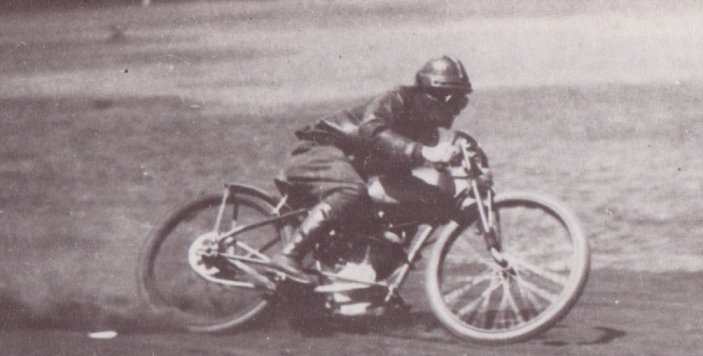
Showing posts with label Dirt Track. Show all posts

Sunday, 23 January 2011

TOWNELEY SPEEDWAY - BURNLEY. A very short lived venue...

The speedway at Burnley opened to a huge 12,000 crowd on March 30th 1929, but faded away less than four months later... Despite the fact that the club had Frank Charles, Joe Abbott and "Ginger" Lees (three of the biggest names in the North) spearheading their team, a fabulous stadium and over 40 riders at their disposal, it just wasn't to be.

Only six speedway meetings were ever held at the Towneley track before it closed for good and although the Burnley team completed five of their English Dirt-track League matches, only one of them was at home. The home match on April 27th was cancelled due to "building work",the match against Leicester on June 29th had to be abandoned and the proposed match against Leeds on June 6th was cancelled due to a shortage of riders! They also had to change the team when the format and rules of the league were changed (some things never change in speedway!), and the original promotion went into liquidation by the end of May and sold out to Percy Platt from Rochdale speedway. Platt's first match in control was really the nail in the coffin of Towneley Speedway as it only lasted 3 heats before it was abandoned due to the excessive dust. The hot weather had brought water rationing to Burnley, so there was no water for the track. The league match against Leeds was quickly re-arranged as yet another Individual Trophy meeting and although it was another successful day for Golden Helmet winner Frank Charles, it was a financial disaster for the new promotion and speedway was never seen in Burnley again. The Towneley stadium continued to host greyhounds until 1933 before it closed down completely.
Newspaper Reports of the Towneley Speedway due to open at Easter 1929
Team photo l-r; Ernest Ingham, E.Thistlethwaite, Jack Lund, Joe Abbott, I.Sanders, J.Rushworth, and Les Martin.
Joe Abbott practising on the Burnley Track and Frank Charles poses with his Douglas
The Mayoress of Burnley cuts the tapes to open Towneley Speedway
The bottom photo shows Arthur Wilcock broadsiding around a fallen rider.
The Burnley Team who beat Salford Albion 41-22 at Towneley on May 11th 1929.
"Ginger" Lees, Arthur Wilcock, Cyril Wilcock, Billy Howard, Jack Lund, Frank Charles, Ernie Ingham and Joe Abbott 
Harold Riley "Ginger" Lees was the Captain of the Burnley team.
Ginger went on to find fame and fortune with Preston, Wembley and England
 He was also a big star at Hamburg.
Frank Charles won the Golden Gauntlets on April 13th, and the Golden Helmet on July 6th.
Frank Charles eventually became a huge star at Belle Vue and Wembley and finished 4th in the very first World Final. He was eventually killed in a gliding accident in 1939.
Joe Abbott was another local lad made good. apart from his free scoring for the Burnley team he went on to become a star for Preston and Belle Vue, and eventually lost his life on track riding for Odsal in 1950.
Burnley Speedway Team 1929
l-r Frank Charles (kneeling), Arthur Taylor (manager) , Arthur Wilcock, Ginger Lees, Jack Lund, Cyril Wilcock (on bike), Ernest Ingham, Joe Abbott and Percy Platt (promoter).
Programme for the EDL match against Leicester on June 29th.
The match was abandoned after heat 3 due to excessive dust. Burnley were leading 13-8.
1929 Map showing Towneley Stadium, the home of Burnley Speedway
...and this what the site looks like today.
The pits were just about where the white arrow is and the footpath running across the centre of the photo is  the same path that runs across the back of the pits wall in the 1929 map. The track is now under part of the municipal golf course.
The road running down the right hand side is the drive to Towneley Hall.

Wednesday, 19 January 2011

"SMOKY" STRATTON - Speedway Trailblazer...

I have a fascination with the pioneer dirt-track riders of the 1920s and 30s, some of whom have featured in previous blog posts, but there are three in particular who have really captured my imagination - Frank Charles, Clem Beckett and "Smoky" Stratton. They all led wildly different lives and were much more than just successful speedway riders. My interest in Stratton was awakened when I discovered he was killed in a road accident just a few hundred yards from my first home in the Lake District. I then discovered that he was buried in a local cemetery and have continued to research his career and visit his grave ever since.

Spencer Charles Stratton, pictured in the UK in 1928.
Spencer Charles Stratton was a true speedway pioneer and a real-life motorcycling free-spirit, always searching for a new and exciting challenge. He left his New Zealand homeland in 1923 aged just 19 to go racing in Australia. Less than 12 months later sailed half way around the World to the USA to try his luck on the American board tracks and eventually landed in Britain in 1928 to join the speedway revolution and quickly became one of the sports first international superstars. He risked his life racing motorcycles on every type of circuit, grass, board, cinders and even concrete, so how ironic that he was tragically killed in a road accident, driving home from a speedway meeting in rural Northern England, a meeting where he wasn't even racing.

Born in 1904, Stratton was the second youngest of 8 children and spent his early years on the family sheep farm at Colyton, just outside of Palmerston North, New Zealand. He was a bright kid, but had a lust for adventure and mischief too, which often got him into trouble. In an effort to control his behaviour he was sent away to Scot's College in Wellington, but managed to get himself expelled!

What drew him into the world of motorcycle racing I do not know. but his racing career appear to have begun in 1922 when he was just 17. One of his earliest meetings was at Marton on February 11th 1922. He made great progress and his first notable victories included the North Island Grass Track Championships and the 1923 New Zealand Middleweight Championships at Stockton. At the age of 19 he travelled to Australia to race and was soon bagging trophies, titles and records virtually everywhere he appeared. One Australian newspaper described him as "the most promising rider of the season" and predicted that Stratton "... will be the leading figure in motorcycling ... next season."

On 7th May 1924, he left Sydney aboard the SS Ventura arriving in San Francisco on May 26th. The challenge? To try his luck on the infamous board tracks of the USA. Whilst he was there he found work in the R&D department at Indian Motorcycles and also acted as a test rider helping to develop the Indian Prince. He also raced on the famous American fairground dirt-tracks, which is where he perfected his broadsiding skills. He returned to Australia later in the year, winning the 15mile Championship of Queensland and setting 6 World Records over 1 mile, 3 miles and 5miles at Brisbane on August 24th using both his 350cc and 1000cc Indian motorcycles. Stratton was also quite an exponent riding his Indians on the fabulous 1 mile banked concrete Olympia Motor Speedway at Maroubra, in Australia and held the track record with an average speed of 103mph. Spencer was also married during his time in Australia, his bride was Monica Agnes Barry and they tied the knot in Melbourne in October 1925.

The infamous Maroubra Speedway in New South Wales, known locally as the "Killer Track".  Stratton set a record of 103mph on the 5/6 mile concrete track riding his 997cc Indian. 
Following this second successful spell in Australia, Stratton returned to the USA in April 1926 in the company of American racing legend, Cecil Brown. Their destination was Springfield again, the home of Indian Motorcycles. Stratton had obviously made a big impression on his first visit to the company as he was soon riding with the Indian Works team and recorded some notable performances on the Milwaukee dirt-tracks and the Altoona, Rockingham, and Fresno Board Tracks. In September 1926, Spencer was to be found racing at the famous Rockingham Speedway in New Hampshire where he was racing against the likes of Art Pechar, Eddie Brink, Reggie Pink and Chuck Remington. He returned down under before the year was out and it was reported in the Canberra Times dated 2nd December 1926 that "... Speeding Stratton registered 95mph on his Indian across the Bredabane Plains". Always pushing himself and his bikes to the limit, Stratton survived an horrific crash at the Hamilton Speedway in Newcastle, NSW, promoted incidentally by another New Zealander, the legendary Johnnie Hoskins. He remained unconscious for 23 days but eventually recovered, got right back on his bike and continued to set records and win titles at tracks in both Australia and on the 1 mile grass tracks in his homeland.

Dirt-track racing (soon to be re-christened Speedway) had arrived in the UK amid a blaze of publicity in 1928 and a flood of Aussie riders made their way to Britain to try and earn their fame and fortune. Smoky was amongst the first to join the exodus, joining promoter and good friend Johnnie Hoskins aboard the SS Oronsay as it set sail from Sydney bound for Southampton. Stratton most likely left the ship at one of the Mediterranean ports and traveled across Europe by train in order to arrive in the UK much earlier. He arrived in the UK sometime during May 1928. 
350cc Indian single, similar to the one used by Smoky Stratton
Smoky loved his 1000cc V-Twin Indian Daytona
At this stage of his career Stratton had been exclusively racing two Indian motorcycles, a 350cc single and a 990cc Daytona Indian Chief, but he switched to riding the famous 347cc Harley-Davidson "peashooter" when he first landed in the UK, switching to the British dirt-track Douglas later in the season. He was one of the first real "Broadsliders" to appear on the British tracks and his name adorned the billboards all over the country -  from Stamford Bridge in London to Marine Gardens and Glasgow in Scotland.

Smoky aboard his Douglas in the UK 1928.
"Smoky" Stratton never really got to grips with the tighter tracks in the UK and reports in the speedway press during 1928 often mention his failure to complete races. He soon spread his wings onto the continent where he could earn a fortune racing for Dirt Track Speedways Ltd. On June 10th 1928 he appeared in front of over 8000 spectators at the Red Star Stadium Speedway in Paris. He also ran his own track in Cologne in front of crowds in excess of 75.000! Motorcycle historian Cyril May described the spectacular German venue in an article in the Speedway Star and News dated 17/12/1967. "Stratton's track gave a lap of 400 yards and was built immediately inside a concrete cycle racing track. The cycle track was banked almost vertically on the bends and on top of this banking, the front rows of spectators stood and looked down. ... Quite a lot of trouble was experienced in the matter of obtaining a permit from the police, who then controlled everything in Germany. Two weeks elapsed before they would give permission for a private demonstration and when some of the boys were at last allowed to put it over, the police ran for cover! It was only when things had been going on smoothly for about ten minutes, free from any slaughter, that they could be induced to spectate. In the end they were all for it."

In 1929 Stratton became a partner in Provincial Dirt Tracks Ltd, the company that built the Owlerton Speedway Stadium at Sheffield in the UK and the White City Speedway at Cardiff in Wales. His partners included fellow riders Clem Beckett and Jimmy Hindle and a businessman named Edgar Hart. Even though his wealth and business portfolio were starting to grow, Smoky still had a thirst for speed and danger and continued to race all over the World, never settling in one place for too long and always looking for the next big challenge. As well as being part owner of Sheffield, he also rode for the Yorkshire team in the 1929 English Dirt Track League and competed in the beach races at New Brighton near Liverpool. In one match report it was said that he flew to Cardiff  from Sheffield to take part in a series of match races, but once again, he failed to complete any of his programmed rides. At the end of the British season he returned to the USA where, reunited with his beloved Indians, he continued his excellent form racing on the board tracks.
Another portrait of Smoky on his Douglas. This looks like the pits area at Sheffield.
Back in the UK in 1930 he joined the Nottingham speedway team and by December of that year he had returned to Australia where he set another World speed record at the Ashfield Autodrome, covering a quarter mile in 17.8 seconds. Whilst in Australia he could often be found riding on the same bill as another New Zealander, Ken Stratton. So far I have failed to determine whether this was Spencer's youngest brother Howard Kenneth Stratton, who was born in 1908. Howards family do not believe that Howard ever raced motorcycles, but who knows for sure?

Spencer returned to the UK again in April 1931 and rode in couple of challenge matches for the non-league Plymouth speedway team, but his performances were well below par. He was still a very active businessman and was seriously considering opening new speedway tracks at Derby and Reading, neither of which came to fruition. Smoky continued to ride on the continent too, and appears to have spent most of the 1932 season riding in Germany and Austria. One such meeting was the very first dirt-track meeting to be held in Vienna on September 1st 1932.

"Smoky" (sitting on the bench), tends to his bike in Vienna 1932.
(© Artur Fenzlau/Technisches Museum Wien - www.technischesmuseum.at )
.
This is the point where Smoky's exploits have become lost in the mists of time. I have no record of the date he returned to the UK, but I do know that at the tail end of 1932, he once again set sail from the UK heading back to Australia. During 1933 he made a brief visit to his youngest brothers home in New Zealand, accompanied by his wife Monica, but Spencer's globetrotting appears to have taken its toll on his marriage too as he and Monica were divorced in Sydney in December 1935. Other than these small facts I don't know his whereabouts or activities until he turns up back in the UK in 1938. I do know that his address was listed as Portsdown Rd, Maida Vale, London when he accepted a calling from his old pal Johnnie Hoskins to take on the role of general manager at the newly re-opened speedway at Brough Park, Newcastle Upon Tyne.

The Newcastle squad included eight Canadian riders at the time and also featured Roland and Maurice Stobbart from Cumberland. Roland was also promoting speedway at the Lonsdale Park track in Workington and had invited some of the Canadian riders to participate in a challenge match at the non-league venue on June 4th 1938. "Smoky" came along as team manager for the night and also acted as driver for the three Canadians, but on the journey home, driving along the Workington to Cockermouth Road, their car was involved in a head on collision with another car near to the village of Brigham.

Stratton was killed instantly, he was only 33 years old. The three Canadian riders, Bruce Venier, Ellwood Stilwell and Robert Sparks all suffered head and facial injuries, as did the occupants of the other car, local driver John Roan and his passenger, George Smith of Whitehaven. All five were taken to the cottage hospital in Cockermouth. Ironically, another Canadian rider was also injured in a car accident that very night. George Pepper, the Newcastle captain, had turned down the chance of riding at Workington as he was due to ride at Edinburgh on the same night. He was involved in a head on collision on his way to Edinburgh and suffered cuts to his leg. The meeting he was due to race in was subsequently cancelled.

Maurice Stobbart had the sad task of identifying Smoky's body at the inquest, which was led by Inspector Woolcock. As "Smoky" had no family living in the UK, it was decided to bury him locally at the cemetery in Cockermouth.

The Inspector and one of his officers escorted the funeral cortege out of town and along the Lorton Road to the cemetery. The whole population of Cockermouth lined the streets to pay their last respects to this great sporting legend. Riders, officials and supporters from the Newcastle and Workington speedway tracks attended the funeral, along with his personal secretary, Miss McQuillan, Mr Ivison, the secretary of the Speedway Control Board, Jimmy Fraser, director of the Edinburgh Speedway and his great friend Johnnie Hoskins. Hoskins had played a big part in Smoky's life and it was only fitting that he should be there at the end too. Hoskins was so upset over Smoky's untimely death that he paid for a gravestone to be erected to commemorate his friend and colleague.

Whenever I visit Smoky's grave I am always pleased to see fresh flowers laid there, but my inquisitive mind wanted to know who put them there as he had no family in the UK to my knowledge. Questions in the newspapers, on the Internet and through the speedway fraternity had led nowhere, but a chance remark by Johnnie Hoskins in a 1967 edition of the Speedway Star and News gave me a clue. Hoskins said... "I still often think of Smoky when he was with me at my Newcastle track in Australia, riding the big Indians in the mid twenties and also of his exploits on the big concrete track of Marouba. Neither have I  forgotten those two devoted speedway supporters that corresponded with me for quite a time after the Stratton tragedy ... they were the ones who so kindly tended 'Smoky's' grave in the little town of Cockermouth"

Then. out of the blue, I received a reply to a note I had left at Smoky's grave, which gave me all of the answers. Inspector Woodcock, the man who had led the inquest and escorted Smoky's coffin to the cemetery, was a speedway fan from the Workington track. His young daughter was also a big speedway fan and felt so sorry for Smoky being buried so far away from his family and homeland that she promised to care and tend to his grave. Both of them wrote to Johnnie Hoskins and through him they traced his family in New Zealand and began to correspond with them too - This young lady kept her promise and laid flowers at the grave every weekend until she passed away herself a few years ago and now her daughter and grandaughter are carrying on the tradition.
Johnnie Hoskins paid for a headstone to be erected on Smoky's grave. Fresh flowers are placed there every week.
The inscription reads...

TO THE MEMORY OF
SPENCER CHARLES STRATTON
SPEEDWAY RIDER
FROM NEW ZEALAND
WHO WAS KILLED AT BRIGHAM
4th JUNE 1938 AGED 33 YEARS
So Spencer Charles Stratton is not alone and I too will continue my little pilgrimage to the quiet, lonely grave of "Smoky" Stratton and pay my respects to a true motorcycling Trailblazer.

(With huge thanks to Dave Gifford, Ross Garrigan, Nigel Bird, Leitha Martin and relatives of Spencer himself for their input, research and information).
Sunday, 7 November 2010

SCOTT - 1928 dirt-track model.

Back in 1928, there was a brand new motorcycle sport sweeping the nation, dirt-track racing, or speedway as it soon became, was a major attraction. Top riders were earning big money and every bike motorcycle manufacturer in the country wanted a piece of the action. Some of the bikes were very good, some were a total failure whilst others were just plain bizzare. Many of them didn't look like speedway bikes at all and were simply road bikes stripped of their lights, brakes and mudguards. It says a lot for the bravery of the pioneer riders that they actually raced some of these bikes on the cinders at all!

One bike that should never have been a success was the Scott... a 500cc twin cylinder two-stroke with water cooling and an unusual low slung frame. Produced in the Yorkshire town of Shipley, this was one bike that definitely did not look anything like a speedway bike... but amazingly, in the hands of a select few riders, the yowling Scott has gone down in history as one of the legendary bikes of the cinder sport.

Jeff Clew described the origins of the dirt-track Scott in his excellent book "The Scott Motorcycle - The Yowling Two-stroke".

The Scott Motor Cycle Company's involvement with dirt track racing occurred in a quite unexpected way. When Frank Varey was detailed to join the Scott riders party to the Isle of Man in the capacity of machine cleaner. Allan Jefferies begged him for the loan of his three-speed Super whilst he was away. Unfortunately, the Super was written off completely in a road accident that followed, when Allan was run into by the rider of a Scott sidecar outfit whose sidecar wheel lifted on a left hand bend. The crash did not do Allan much good either, for he suffered a fractured skull, cheekbone and jaw.

When he ultimately emerged from hospital it was obvious that a machine would have to be built from scratch, since even the Super's crankcase had been cut in two by the force of the impact. Putting their heads together, Frank and Allan decided they might as well build a machine that could be ridden on the cinders. And so, from a quite calamitous beginning, a dirt track Scott began to take shape. To assist with the finances, Allan promoted two meetings at the nearby Greenfield Dog Track and at various tracks in Lancashire.

According to Allan, it was Frank's superhuman strength and courage, coupled with their complete ignorance of steering geometry that made Frank such a spectacular favourite with the crowds. His lurid style of riding and the scream of the Scott on full power drew spectators in large numbers and soon word got around to Harry Langman, who took such an interest in the project that it was decided to add a dirt track model to the official Scott range. Cecil Knowles of the Frame Shop organised production, using a frame that was a cross between that of the Flyer and the Super, a formula worked out by Frank and Allan the hard way.

The dirt track model neared completion one Saturday lunch-time, on the day when Frank was due to ride his own model at Bolton the same afternoon. Anxious to give the new model an early try-out, Allan agreed to remain at work so that the new model could be completed in time for delivery to Rochdale Town Hall Square by tea-time, to enable Frank to try it at an evening meeting in Salford. In return, Allan would take over the old machine, so that he could have a ride at Rochdale.

Like all deadlines, the completion of the machine was met with some difficulty, but Allan eventually set off for Rochdale, just in the nick of time. Both riders agreed to meet up towards midnight at a much-favoured steak pudding shop in Littleborough, where there was a parrot they were teaching all kinds of quite unmentionable phrases. When they finally got together, Frank was clutching a Golden Helmet, the major award presented to the star of the meeting at Salford. The parrot learnt much that night during the session that followed.

El Diablo Rojo - Frank Varey on the Scott that brought him glory as a pioneer speedway star.
The Scott employed an open frame and a TT engine, and it was said that the Heart-rendering yowl of this particular machine was terrifically exciting. The dirt-track model had a 3-speed gearbox, specially braced Webb forks of the old type, (later fitted with "Super Squirrel" type forks) a smaller than standard radiator and a very neat exhaust system. There was no Kick start on these Scotts and the entire Primary and magneto transmission was enclosed, the abscence of exposed mechanism was a noteable feature. The cost of a brand new machine in 1928 was £95.
The legendary Frank Charles from Roose near Barrow-In-Furness aboard his Scott in 1929
Juan Pagano, another Belle Vue rider who favoured the Yorkshire built Scott
The bike really did require an unorthodox riding style and mighty muscles to manhandle it around the cinder bends. Very few mastered it, but Frank Varey, "El Diablo Rojo" as the fans called him, (yes the Red Devil himself) got the necessary technique off to a tee, even though it's lack of ground clearance led to chamfered frame tubes after every meeting. Other riders who rode the Scott included Arthur Franklyn, Frank Charles and Oliver Langton. Wilf McClure even raced a banking sidecar outfit using a dirt-track Scott. Frank Varey must have liked unusual bikes because when he eventually fell out with the Scott owners he changed his steed to a Norton, another bike with a short production run and featured in my earlier post here. His Scott eventually ended up in the hands of another Belle Vue rider, Frank Burgess who rode the bike with some success at Workington and Barrow in the early 1930s.
</></></></></></>
Frank Burgess in action at the Holker Street track, Barrow-In-Furness, 1930.
*Footnote* Even though Frank Varey is always associated with riding a Scott, he only actually rode the machine on the dirt-tracks for 18 months. He rode it throughout the 1929 British season and took it to Argentina with him during the winter. When he returned to the UK in the spring of 1930, Varey was dismayed to find that the factory had done nothing to improve the DT Scott at all as they had been concentrating on developing a brand new 5-cylinder car engine. Varey walked out on Scott and after a brief flirtation with Norton he turned his allegiance to the Rudge. Ironically, Scott went into recievership shortly afterwards.

Saturday, 31 July 2010

BSA SAND RACER

Jim Scott's B31 BSA Sand Racer
(Photo by - MotoFreakoFoto)
The years immediately following WW2 were some of the best for grass track and sand racing in Lancashire and Cumberland. Even some of the smaller events could attract crowds of 5000 or more.

Sand races were held on the wide open sands of the Solway Firth and Morecmbe Bay, from the famous beach races at Southport Sands up to Skinburness near Carlisle. The bikes were mainly stripped down roadsters, with a smatttering of pre-war speedway and grass track bikes thrown in for good measure. The races were a mixture of straight line sprints and half-mile and one-mile ovals.

This particular bike is a single cylinder 350cc BSA and was raced by Jim Scott on the beaches at Skinburness, Morecambe and around Barrow-in-Furness. Jim had also been a novice speedway rider at Workington's Lonsdale Park during the early 1930s. This bike was rescued from a house clearance by John Fisher of Wiltshire and has now been restored as a B31 road bike. Personally, I think that's a shame. I would have kept it in its mean looking Sand Racing trim and preserved a bit of British Racing history.

Sunday, 13 June 2010

NORTON DIRT TRACK - 1930.

During 1930, Norton motorcycles, a company far more famous for it's road racing machines, produced a dirt-track model for the new sport of speedway. The sport was enjoying a real boom era and most of the British manufacturers tried to produce a machine that would put them in front of the considerable crowds gathered around the cinder ovals.
Norton used a modified version of their ES2 engine and a simple countershaft fitted in a standard sturmey archer gearbox shell. The front forks were Webb speedway items and it was all attached to a modified diamond frame. It was not a success though. Unfortunately for Norton, J.A.Prestwich of Tottenham had launched their legendary speedway motor at around the same time and by August of that year, the J.A.P had become the engine of choice for most speedway riders.
One speedway model Norton was still in regular use into the 1980s as a Wall of Death machine in the Netherlands. The machine was almost original too only missing the stand and the lower chain stays. The owner had also fitted a set of gears into the gearbox shell.
This illustration is taken from my friend Jeff Wilson's photostream on flikr where you will find many more illustrations of vintage dirt track machines. Information taken from "The Pictorial History of Norton Motorcycles" by Jim Reynolds. Published by Temple Press in 1985. (ISBN 1 85152 905 5)

Monday, 10 May 2010

CHRIS TATTERSALL - Lancashire's Racing Blacksmith.

"Spud" Tattersall was a real pioneer speedway rider in the UK. He entered the very first dirt track meeting at Audeshaw, nr Manchester, in March 1928 and reached the final of the 350cc class on an A.J.S. He also competed in the very first dirt track meeting at Highfield Road Trotting Track in Blackpool in April of the same year. Chris went on to ride regularly at both the Blackpool dirt track venues, (Highfield Road and St Annes Road) before becoming a member of the Preston speedway squad from 1929 to 1932 Chis also rode at the two Barrow-In-Furness tracks in 1930 and 1931.

As well as his exploits on the dirt tracks, Chris was a big fan of the TT and first rode in the Junior TT in 1928, finishing 10th on a D.O.T. He went on to compete in the Lightweight TT every year from 1929 until the outbreak of war in 1939 with a best position of 5th in 1932 on his own CTS machine (Chris Tattersall of St Annes.). He also had a go at the Senior TT in 1931, 33, 35 and 37 and also the Junior TT again in 1931 but registered a DNF in all of these. When racing returned to the Isle Of Man in 1947, so did Chris with his CTS. He was back again in 1949 and continued to race at the TT until 1953... some 25 years after his debut. The photograph above shows Chris at the 1934 TT where he finished 7th in the lightweight event on his J.A.P. engined CTS

Incidentally, he was nicknamed "spud" due to his love of potatoes, often eating a plate of nothing else... mashed, boiled, roasted, fried, you name it he'd eat it as long as it was made of potatoes!
___________________________________________________________________
*Additional Information*
The National Motorcycle Museum, near Birmingham Airport, has recently purchased one of Chris Tattersall's old racing machines, a 1949 250cc CTS Python. Although CTS was assumed to stand for Chris Tattersall Special, it seems that the S actually stood for his home town of St Annes, near Blackpool. The original CTS of 1931 had a JAP engine but in the post-war years, when Tattersall was preparing machines for other riders machines,  the engines were 250cc Rudge Python four-valve units with four-speed gearboxes of the same make. Former blacksmith Tattersall and his sole employee Bill Dawes devised plunger rear suspension for the Rudge frame. The cycle parts on this particular bike are known to be from the CTS that Les Martin crashed when lying fifth in the 1949 250cc Lightweight TT. Coincidentally, Leslie.G.Martin was also a former speedway rider, having ridden for his home town team Burnley in the 1929 English Dirt Track League.

Monday, 26 April 2010

HARLEY-DAVIDSON - "PEASHOOTER"

No brakes, no gears, no problem! The Harley-Davidson “Peashooter” was a full-on racing machine. Anything that didn’t help it go faster was just dead weight that was removed in a quest for victory.
Introduced in 1926, the 350cc singles were Milwaukee's response to Indian's Prince of the same displacement. They came in two variants, an economical side-valve for general lightweight transportation, or the more ferocious over-head-valve version. Known as the 'Peashooter' because of its staccato exhaust note, the 350cc roadster engine produced 8 horsepower, while the OHV racing version produced 12 horsepower and came equipped with a magneto.
The racer gained its performance advantage thanks to special combustion chambers designed by British engineer Harry Ricardo. A design feature called a 'squish band' created turbulence in the fuel charge, resulting in a fuller burn and thereby greater horsepower. In addition, the competition Peashooter engine also featured pressure oil feed to most of the bearings and had a sodium-cooled exhaust valve. It also featured a shorter wheelbase than the roadster and weighing only 215lbs, the racing "Peashooter" possessed an excellent power-to-weight ratio too.
Although introduced in the mid-1920s, the Peashooter's heyday was the early 1930s. By this time virtually all the expensive-to-maintain banked wooden board tracks closed and the focus of American motorcycle sport shifted back towards flat-track racing where the 350cc Harley excelled in the 21' cubic inch "Class A" . Flat track racing had started in the early 1900s on half-mile and mile-long horse tracks which were loosely  surfaced, hence the alternative name of "dirt-track" racing. The "Peashooter was also exported and proved its worth on the speedway circuits of Australia and Europe.
Harley-Davidson factory rider Joe Petrali
By the mid-1930s the focus of American racing had switched to the production-based "Class C" machines and the British J.A.P. engine had replaced virtually everything in the speedway world... The "Peashooter's" day had passed.

Sunday, 25 April 2010

CYCLONE- 1913-1916.

The Cyclone is probably one of the most purposeful bikes of all time and was certainly way ahead of its time in terms of engine build and performance. The bike was built by Joerns Motor Manufacturing Company of St Paul, Minnesota, USA, which itself grew out of the Thiem Manufacturing Company, an engine builder which operated from 1903 to 1911. Board-track and dirt-track motorcycle racing were big money earners in America during the early 20th century with Indian and Harley-Davidson leading the way and then Cyclone came onto the scene in 1912 with their 1000cc, over-head cam v-twin.
The bevel drive ohc engine was designed by Swedish engineer, Andrew Strand, and was possibly the most powerful motorcycle engine of the day. The motors ran very well and were very strong but the frame was really nothing more than a modified bicycle frame with an unpadded leather saddle and even bicycle pedals.
While racing a Cyclone in 1914, development engineer J.A.McNeil set a new speed record of 111 mph, beating the Excelsior of Lee Hummiston at 100mph (yes this was 1914!). The quality of the workmanship was very high in most regards, as the motors were machined to very high accuracy. Ultimately, the motors and the bikes were not as reliable as more conventional designs. Some races were lost due to mundane issues like cracked fuel tanks or broken chains, but some were lost due to exhaust valve and piston breakages.
J.A.McNeil on a Cyclone
Racing is what Cyclones did best, and the name most closely associated with them after that of designer Andrew Strand is Don Johns, perhaps the most successful of all Cyclone riders. In a 1941 magazine interview, Johns recalled some things about the legendary Cyclone... "The yellow rig attracted a great deal of attention wherever I raced it. It used special Swedish precision bearings and was very light and very powerful. The motor was so powerful that I would wear out a set of tires in just a few laps. I switched from U.S. Tires to a newly designed Goodyear and that helped. It was the first racer to turn over 5000 rpms. It had a unique sound and was often five to seven miles per hour faster than the other factory rigs."
Don Johns on his Cyclone
One legendary victory for Johns on the Cyclone was a winner-take-all one-lap race around a mile dirt track in Phoenix on November 18, 1913. The promoter offered the princely sum of $1000 to the vehicle that could lap the mile the fastest – that included planes flying just above the mile oval. Johns and the Cyclone beat the automobile ace Barney Oldfield and barnstorming pilot Lincoln Beachly to win the prize.
The Cyclone, while often the fastest motorcycle at a race, suffered from reliability problems. Johns easily turned the fastest lap times and many times built big leads only to suffer mechanical problems with the bike. The most infamous race for Johns and Cyclone was the epic 1915 Dodge City 300. A total of seven manufacturers fielded factory teams in the event. Harley-Davidson, debuting in the classic race, and Indian each had eight riders. Johns, on the Cyclone, turned laps over two mph faster than Dave Kinney’s qualifying speed in the early laps and was heavily favoured to win the race. He opened a large lead, lapping a number of riders in the first fifty miles. Then the bike began to fade and he lost the lead just before the 100-mile mark and later dropped out of the running. Johns also lead similarly in the 100-mile national at Ascot Park until the Cyclone again failed before reaching the chequered flag. Johns did win a number of shorter races on the Cyclone, including the 1 mile FAM National held in Sacramento in July of 1915.
The company owners of Cyclone had little experience or even interest in marketing, building up dealerships or service, production was slow and expensive, profits were minimal, so the owners eventually stopped production in 1915 after no more than 300 Cyclones had been built. A number of ttempts were made to revive the Cyclone. Firstly, in 1916, a Chicago businessman bought the assets and moved the machinery, partially completed bikes and all the remaining parts to Chicago, where they were stored in a warehouse. Two other investors got involved, but were unable to get the business up and running. Four years later, the left-overs were sold and moved to Cheboygan, Michigan, where a building was put up and production was set to resume. This never happened either and another move to Benton Harbor, Michigan was made. Another factory was prepared and Andrew Strand was brought in to update the design. A new Cyclone with a three-speed transmission (reportedly based on an Excelsior unit) was displayed and adverts appeared in motorcycling magazines. Again, nothing came of it. The Cyclone's last gasp came in 1923. A racer called the Reading-Standard competed in several races. As it turned out, this was a Cyclone bearing a different name on its tank. Reading-Standard (itself recently purchased by the Cleveland Motor Company), had acquired all remaining Cyclone assets and put together one last racer from left-over parts.
A painting of a 1916 Cyclone by Don Bradley

Engine: 45degree OHC V-Twin 
Capacity: 1000cc
Horsepower: 45bhp
Wheelbase: 53" (135cm)
Weight: 260lbs (118kg)
Top Speed: 110mph (177kph)
Cost: $350

Friday, 23 April 2010

CROCKER SPEEDWAY BIKES 1931-34

Interest in European-style speedway had exploded in the USA after its introduction by Lloyd "Sprouts" Elder during 1931. Several high school sports fields in the Los Angeles area had been turned into speedway tracks during the summer vacation. Local Indian dealer, Albert "Al" Crocker was fascinated with this new sport, so, in partnership with his chief engineer Paul Bigsby, they decided to build their own speedway bike. The initial 1931 prototype was a special Crocker frame into which they installed a regular 45 cubic inch (750cc) sidevalve Indian 101 Scout engine. Satisfied with this frame design, Crocker next turned his attention to a better engine, so for the 1932 campaign several Scout engines were converted into 30.50 cubic inch (500 cc) overhead valve units.
1931 OHV Crocker Indian V-Twin
The first of the Crocker-powered overhead valve singles appeared at Emoryville Speedway in California in November 1933. Cordy Milne rode the machine in twelve races and took nine first places and one second place during the meetings held on November 11th and 14th. His brother Jack had four first places during the same two meetings. Other top riders who used the first Crocker dirt trackers were Miny Waln, Earl Farrand and Snooky Owens, so the marque was well represented.

Unfortunately for Al Crocker, the British J.A.P. powered bikes were beginning to dominate speedway in Europe and were rapidly replacing the Douglas and Rudge machines which had dominated the sport since 1928. The 40hp Crocker proved itself the equal of the Rudge, and was superior to the Harley-Davidson CAC. However, the J.A.P. machines were good for 42-43 hp, so Crocker's new baby needed further development to be competitive. He therefore had two overhead cam motorcycles built during 1934, one of which was ridden a few times by Miny Waln. The 1934 Crocker catalogue stated....
"These machines competed continually at Long Beach, San Diego, Los Angeles, and Santa Ana. In the winter they were sent to Mexico City for a series of eighteen races, where practically every event was won by a Crocker machine. Competition with the imported equipment forced the decision in favour of a newly designed power plant - a type which would have acceleration, the right power output, low cost of maintenance plus a low first cost. A single cylinder type was decided upon."
Meanwhile, Crocker's attention was turning to a long cherished dream of building the fastest road-going motorcycle in the nation - perhaps the world. Facing stiff competition from the J.A.P. engines, and not being a true factory owner, he abandoned his shop-built speedway bikes at the end of 1934 to launch the far more famous Crocker v-twins which debuted in 1936. During the speedway project, the Crocker machine shop had built between forty and fifty of the pushrod speedway motorcycles.
Key specifications of the 1934 Crocker speedway machine:
Bore: 3 1/4 in (82.55mm)
Stroke: 3 5/8 in (92.085mm)
Displacement: 30.06 cubic inches
Compression Ratio: 14 : 1
Crankpin: 1 1/8 in, drilled for oil
Main Shafts: 1 in, with 7 degree taper
Bearings: roller for mainshafts and crankpin
Valves: 1 3/4 in, set at `close angle' in `shallow domed interior'
Valve Springs: three coil springs per valve
Ignition: gear driven Lucas magneto
Carburetor: two bowl Amal
Power Peak: at 6,000 rpm
Fuel: alcohol
Frame: chrome molybdenum tubing
Gear Ratio: for 1/5 mile track, 8.75 : 1
Weight: 235 pounds
Cost: $385
Information taken from the Book "American Racing Motorcycles" by Jerry Hartfield.

About Me

My photo
Whitehaven, Cumbria, United Kingdom
Disenchanted City Boy who rode out of the fast lane and into the back lanes! Life on Two Wheels is so much fun.