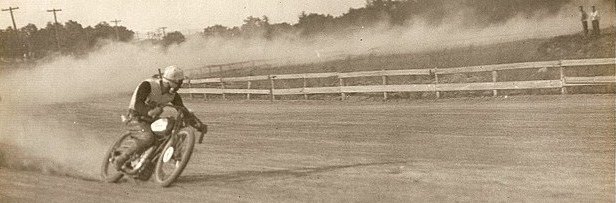
Showing posts with label Speedway. Show all posts

Saturday, 12 March 2011

Harry Skirrow - "The One-Armed Lakeland Wonder"

"Perhaps the least known and most underrated racing car constructor in this country". That is how author Derek Bridgett described Henry (Harry) Skirrow in his book "Midget Car Speedway". That statement is very true. Without a doubt, it was Harry's skill, drive and initiative that produced the UK's most successful midget speedway cars, but there was so much more to this great man than has ever been published before.
Born in Bradford in 1906, Harry was raised in Westmorland (now part of Cumbria). Harry began his working life as a banker, but he soon became bored with the mundane occupation and opened his own motor garage on Lake Road in Ambleside, close to the shore of Windermere in England's Lake District.

During their teenage years, the brothers had both been bitten by the motorcycle bug and competed in sand races, speed trials and grass track events and they were both founder members of the reformed Westmorland Motor Club. Harry and Geoffrey were pioneer speedway riders too. Harry had finished 2nd to his brother in the 350cc event at the first Whitehaven meeting in July 1930 and they were both winners of the Silver Goblet and Silver Rose Bowl at Barrow-In-Furness speedway during the same year. At one stage Harry was a promising novice at the Preston speedway track, but then he lost his left arm in a shooting accident and everyone presumed his motorcycle racing days were over - everyone except Harry that is! With the aid of an artificial forearm and a hook, Harry started riding again and even amused himself by riding speedway again, albeit behind closed doors at the famous Belle Vue track in Manchester. He was such a fan of the sport that he would drive down to Manchester to watch the "Aces" most weeks and it was here that he first saw Midget Car Speedway. On May 16th 1935, Belle Vue Speedway presented an "All Car Meeting", which was reported as a failure, but it obviously caught the imagination of some and fired a new enthusiasm in Harry Skirrow.

Harry returned to Ambleside and built his own midget racer based on the wreck of an old BSA Scout. He returned to Belle Vue as a competitor and despite having the fastest car around the Manchester track, he was still not satisfied. With the help of Walter Mackereth, a blacksmith from Kendal, they built a new car and took it to Flookburgh Sands for testing. They experimented with front wheel drive, rear wheel drive and different wheelbases until they eventually produced a car that they were both satisfied with and turned their attentions to domination of the UK midget speedway car scene.
The fully developed "Skirrow Special" from 1936
(Photo courtesy of Malcolm Skirrow)
I have a copy of a letter drafted by Harry on various scraps of paper and intended to be sent to Michael Ware at the National Motor Museum in Beaulieu that tells the story of how the famous Skirrow Special developed...

In the letter Harry describes how, with more enthusiasm than judgement, he sold his garage at Ambleside and put all his resources into producing a car that fulfilled the rules of midget car racing in the USA. He then relocated to London and rented a workshop from Victor Martin in Tottenham. Harry had asked the neighbouring firm of J.A.Prestwich to produce a 1000cc air-cooled v-twin engine based on two 500cc speedway J.A.P. units. The two cylinders were mated to a common crankcase and each cylinder had its own twin monobloc Amal carburettor and ran on methanol. This engine became known as the 996cc J.A.P. 8/80. The chassis and pressed steel disc wheels were produced by Rubery Owen and Harry also persuaded John Bull to produce special tyres using the same tread pattern and compounds as the larger 20" speedway bike tyres.
996cc J.A.P. 8/80 engine.
A cutaway showing the 4-wheel drive chassis of the Skirrow.
By the Spring of 1936 Harry had produced his first few complete cars and presented them to Eric Spence at Belle Vue Speedway. At first he wasn't interested as he wanted to produce his own cars based on the American Elto design, so Harry became a partner in Liverpool Speedway which allowed him to race and demonstrate his cars to his hearts content. It wasn't long before the Skirrow was recognised as the best car for the job and Harry eventually joined forces with Jim Baxter and the Belle Vue management to form a national midget car racing league with Harry and his wife promoting their own tracks at Lea Bridge in London and at Coventry in the Midlands.
Action from Coventry in 1937.
Ginger Pashley in an Elto leads Walter Mackereth in a Skirrow.
Not only was Harry a talented designer, fabricator and a budding businessman, he was also an exceptional driver. In his book "Coventry's Two Speedways", author Colin Parker describes how Harry managed to turn his car onto its side during a meeting at Wembley. He scrambled out, pushed it back onto four wheels with his single arm and carried on racing. The same book also describes how the cars had to be transported from their Tottenham workshops to the Brandon track at Coventry, either on the back of a truck or being towed behind it, with the "driver" exposed to the elements in all kinds of British weather.
Harry sitting at the wheel of the final development of the Skirrow Special.
(Photo courtesy of Malcolm Skirrow)
In his letter Harry continues to describe the diffficulties he faced. Despite being totally under capitalised and running into severe financial difficulties during the recession of the 1930s, Harry did not give up on his dream and persevered with developing his Skirrow Special and promoting racing or "Doodle Dicing" as it had become known, at more venues. He had plans to introduce his "Doodle Bugs" to the Moorville Speedway in Carlisle in partnership with Roland Stobbart and Jimmy Baxter, but the venue never recovered from the financial disaster of its one and only motorcycle speedway meeting and the proposed project never materialised. 
Coventry driver Frank Chiswell in his Skirrow No 77.
(Photo courtesy of Roy Chiswell)
Walter Mackereth and his Coventry team were crowned League Champions in 1938 and Harry was just beginning to reap the rewards of his dogged determination. Crowds were increasing and Harry had been invited to tour Australia over the winter of 1939/1940, but the events that followed were completely out of Harry's hands. Poor summer weather in 1939 had caused a lot of meetings to be rained off and combined with gathering war clouds, the midget car league was abandoned in July 1939. Consequently, the trip to Australia was also cancelled. Fate dealt another blow in 1940 when Harry's house was completely demolished during an air raid, destroying all of Harry's records, drawings, photographs and press cuttings. At this point Harry sold his business to Victor Martin, paid off his debts and relocated back to the North West to join his son Malcolm, who had already been evacuated from London and was living with an Aunt in Bowness-On-Windermere. The family eventually settled into a house just south of Lancaster and Harry turned his attentions to producing aircraft parts for the war effort. He joined forces with William "pops" Kitchen, a former partner of his at Liverpool speedway and the father of Belle Vue speedway star Bill Kitchen, in a small factory unit in the village of Galgate.

After the war had ended there was no immediate resumption of midget car racing and Harry found that he had lost touch with his associates and his cars. More importantly, Harry wasn't willing to take any more financial risks having lost everything in the 1940 air-raids. Bill Kitchen and his brother Jack were due to be demobbed from the Army and would be returning to the family business, so Harry decided it was time to move on again, this time to Devon.

The family bought a house in Maidencombe, just outside of Torquay and Harry persuaded his brother Geoffrey to join them. The two brothers bought a market garden and then sold it for a hefty profit in 1947. Their next venture was to buy the Loughton Motor Company in London together with some war surplus Nissan huts, which were erected next to the garage and rented out as storage.

Harry had managed to recover three badly damaged Skirrow cars from the remains of his garage at the bombed out house in London and had taken them to Devon where he rebuilt two and sold them. The third chassis became a donor for a single-seat sports car that Harry built in order to travel to London and back whilst overseeing his business. The car was described as looking like a miniature Allard. It used the same 996cc 8/80 J.A.P. engine as the midget racers with the addition of a 4-speed motorcycle gearbox, which Harry modified to give the car a reverse gear. Unlike the racing cars, this road legal Skirrow was front wheel drive, ran on petrol and could return 70mpg at a steady 60mph.
Harry with his home-made sports car, which he drove to London and back on a regular basis.
Eventually a compulsory purchase order was put on the garage to allow for the construction of a new road and harry and Geoffrey were out of a job. Geoffrey found some part-time work helping out at the local service station at Chudleigh and Harry spent most of his time indulging in his new hobby - sailing, but they both became bored without regular work and bought the Maidencombe Service Station in 1952.

Harry sailed a 14 feet redwing yacht with the Babbacombe Corinthian Sailing Club, where he built and installed a motorised winch to haul the boats up the beach and also built trailers for other club members. Harry still had a strong competitive streak too and was awarded the prestigious Sir Reginald Leeds Trophy in 1959 after nine consecutive race wins in the Torbay Regatta and two race wins at Falmouth.
Harry out sailing in 1953.
(Photo coutesy of Malcolm Skirrow)
When Geoffrey died, Harry sold the garage and gave half the proceeds to his widow. He then went to work for his son Malcolm at his garage in Babbacombe, travelling to work and back every day on a 90cc Honda Cub. Even though Harry always said he never wanted to retire, his Doctor had other ideas and in 1984 Harry finally went home for a rest aged 77 and eventually passed away in 1991 at the age of 84.

He was once asked in a newspaper if having only one arm had made life difficult... "Oh no" he said, "If I had another arm I just wouldn't know what to do with it, I can do most jobs and if I'm beaten I just ask for help. With this hook I can hold a welding rod right down to the last bit without burning my fingers, but there are some things that are on the official list of things I can't manage, like the washing up".

Shortly before he died Harry said to his wife... "I think I've done just about everything in life that I wanted to", to which his wife replied... "Yes - You bloody well have!".

But what became of the Skirrow cars? Victor Martin continued to provide service and spares after the war under the name of "Skirrow Special Cars Ltd" and his friend and colleague Walter Mackereth continued to race with great success in Hamburg and Paris. Most of the remaining cars were purchased by David Hughes, a midget car racing enthusiast from the East Midlands, who had built his own racing track in 1949 at Brafield in Northamptonshire. Hughes then took the Skirrows on tour in 1950 followed by the formation of  the Midlands Midget Speedway Car League in late 1951. Sadly, the league featuring teams from Birmingham, Cradley Heath, Coventry and Leicester was short lived and was abandoned before the year was out. By the end of the 1950s the cars were beginning to wear out and Victor Martin was no longer able to provide back-up. Some of the cars were cannibalised to keep others going but Hughes eventually had to admit defeat. Thankfully a few Skirrows have survived and are now in the hands of enthusiasts and collectors who acknowledge the historical importance of the Skirrow Special.
A preserved 1938 Skirrow Midget Speedway Car. Originally from Canada, this car was recently sold at auction and is now in Australia. Although not completely original, it does represent Harry's later development of the Skirrow vey well. This particular car has been discussed at length on Midget Car Panorama (see link at foot of page).
Massive thanks to Harry's son Malcolm Skirrow for letting me have copies of Harry's letters, photographs and giving me a potted history of Harr'y life. Thanks also go to Derek Bridgett, Colin Parker and Roy Chiswell, and also to Percy Duff and the late Bernard Crabtree for sharing their memories of Harry.


References:
Midget Car Panorama - A Forum for Midget Car Racing.
Midget Car Speedway by Derek Bridgett
Coventry's Two Speedways by Colin Parker
and various Stock Car Racing articles by John Hyam.

Sunday, 27 February 2011

Barrow Speedway - A (very) brief illustrated history

The origins of speedway and dirt-track racing on the Furness peninsular can be traced back to he beach races organised by Barrow & District Motor Club in the 1920s. The club later held a grass track meeting at the Little Park Rugby Ground in Roose on May 26th 1928. The winner of the unlimited races at this meeting was local hero and future Belle Vue and Wembley star Frank Charles , who literally lived over the road from the stadium on North Row, Roose. In 1930, the Northern Motor Sports Club introduced Speedway racing to the Holker Street football stadium. A track made of rolled ashes from Vickers Shipyard was laid around the football pitch and a total of seven meetings were held before the Football club needed to re-turf their pitch in readiness for the new season. The winner of the opening meeting on 12th June 1930 was Eric Airey from Lancaster and over 7000 spectators watched the final meeting on July 28th.
Frank Charles and Eric Airey get ready for a match race at Holker Street in 1930
Not sure of the rider in the white jersey, but the other 2 riders are Roland Stobbart and Frank Burgess.
 A rare action shot from Holker Street in June 1930
During the 1950s, Cliff Hindle, a local motorcycle enthusiast, built his own private circuit where he and several other enthusiasts could practice prior to riding at Belle Vue and Sheffield, but it wasn't until 1972 that speedway racing returned to Barrow-In-Furness. A new track was constructed around the pitch at Holker Street and Barrow enjoyed three unsettled seasons of league racing at the football stadium, firstly with the Barrow "Happy Faces" who finished 9th in the 1972 second division, and then the Barrow "Bombers" who finished around mid-table in the 1973 and 74 seasons. The football and speedway clubs were uneasy partners though and talks broke down right on the eve of the 1975 season and Holker Street closed its doors to speedway again.
Mike Watkin - 1972
Bob Coles - 1972
Local rider Ian Hindle - 1972
Tom Owen - 1973
Terry Kelly - 1973/74
(Photos above all by R.Spencer-Oliver)
Sid Sheldrick in action at Holker Street 1974.
(Photo by Roy Dixon)
Chris Pusey of Belle Vue leads Chris Roynon at Holker Street in 1974
(Photo by Roy Dixon)
Cliff Hindle enters the scene again in 1977 by building a brand new track and stadium at Park Lane on the outskirts of Barrow. After a season of challenge matches, the "Furness Flyers" entered the 1978 National League, but a weak team finished bottom of the league with only 18 points to their credit and the track did not reopen in 1979. Speedway did make a brief return to Park Lane in 1981 when the temporarily homeless Berwick "Bandits" used the track for 5 league matches and 1 KO Cup match.
Chris Roynon and Andy Reid - 1978
(Photo by R.Spencer-Oliver)
Geoff Pusey - 1978
Chris Robins - 1978
 In 1983, Chris Roynon purchased the derelict stadium from Cliff Hindle and rebuilt it. Throughout the year he ran monthly stock car meetings and occasional speedway training sessions. A series of seven "open" meetings were then staged in 1984, four of the matches featured the Barrow "Blackhawks" racing in challenge matches and another featured the Barrow "Braves", a team comprised of junior riders. The "Blackhawks also competed in one away fixture at Edinburgh. The Barrow "Blackhawks" entered the 1985 National League, but this was possibly the weakest team ever seen in National League speedway and they were expelled from the league in May. Roynon continued to promote challenge matches and individual trophy meetings at an intermediate level, culminating in the Cumbrian Open Championship on Sept 24th 1985. The last ever speedway meeting to be held at the venue. Stock meetings continued until 1987 when the track was covered over with a greyhound track. Prior to demolition in 1994, local motorcycle dealer Martin Crooks and teenage prospect Grant McDonald used the old track for practice session, but the bikes have remained quiet ever since.
Rob Grant of Berwick leads Kevin Armitage and Gary O'Hare - Park Road 6th May 1985
Jim Mcmillan and Rob Grant lead Gary O'Hare and Paul Price - Park Road 1985
A Fabulous view out into Morecambe Bay too
Eric Broadbelt, Rob Grant, Bernie Collier, Bruce Cribb - Park Road 1985
(Park Road photos by Philip Haynes)

Update; February 2013: Due to the feverish enthusiasm of Barrovian John Earnshaw, Barrow "Bombers" will return to the track in 2013. On Sunday September 8th at 2pm, the new Barrow "Bombers" will take to the track in an amateur challenge match at Northside Speedway, Workington. John has designed a new bib for the grand occasion and the team has already booked Rob Shuttleworth from Askam to represent his local team.

The new race bib for the 2013 Barrow Bombers... 
This is the first step towards his ultimate goal of bringing speedway back to Barrow-In-Furness. Check out the Barrow Speedway website or take a look at the facebook page for more information and nostalgia.  

Sunday, 23 January 2011

TOWNELEY SPEEDWAY - BURNLEY. A very short lived venue...

The speedway at Burnley opened to a huge 12,000 crowd on March 30th 1929, but faded away less than four months later... Despite the fact that the club had Frank Charles, Joe Abbott and "Ginger" Lees (three of the biggest names in the North) spearheading their team, a fabulous stadium and over 40 riders at their disposal, it just wasn't to be.

Only six speedway meetings were ever held at the Towneley track before it closed for good and although the Burnley team completed five of their English Dirt-track League matches, only one of them was at home. The home match on April 27th was cancelled due to "building work",the match against Leicester on June 29th had to be abandoned and the proposed match against Leeds on June 6th was cancelled due to a shortage of riders! They also had to change the team when the format and rules of the league were changed (some things never change in speedway!), and the original promotion went into liquidation by the end of May and sold out to Percy Platt from Rochdale speedway. Platt's first match in control was really the nail in the coffin of Towneley Speedway as it only lasted 3 heats before it was abandoned due to the excessive dust. The hot weather had brought water rationing to Burnley, so there was no water for the track. The league match against Leeds was quickly re-arranged as yet another Individual Trophy meeting and although it was another successful day for Golden Helmet winner Frank Charles, it was a financial disaster for the new promotion and speedway was never seen in Burnley again. The Towneley stadium continued to host greyhounds until 1933 before it closed down completely.
Newspaper Reports of the Towneley Speedway due to open at Easter 1929
Team photo l-r; Ernest Ingham, E.Thistlethwaite, Jack Lund, Joe Abbott, I.Sanders, J.Rushworth, and Les Martin.
Joe Abbott practising on the Burnley Track and Frank Charles poses with his Douglas
The Mayoress of Burnley cuts the tapes to open Towneley Speedway
The bottom photo shows Arthur Wilcock broadsiding around a fallen rider.
The Burnley Team who beat Salford Albion 41-22 at Towneley on May 11th 1929.
"Ginger" Lees, Arthur Wilcock, Cyril Wilcock, Billy Howard, Jack Lund, Frank Charles, Ernie Ingham and Joe Abbott 
Harold Riley "Ginger" Lees was the Captain of the Burnley team.
Ginger went on to find fame and fortune with Preston, Wembley and England
 He was also a big star at Hamburg.
Frank Charles won the Golden Gauntlets on April 13th, and the Golden Helmet on July 6th.
Frank Charles eventually became a huge star at Belle Vue and Wembley and finished 4th in the very first World Final. He was eventually killed in a gliding accident in 1939.
Joe Abbott was another local lad made good. apart from his free scoring for the Burnley team he went on to become a star for Preston and Belle Vue, and eventually lost his life on track riding for Odsal in 1950.
Burnley Speedway Team 1929
l-r Frank Charles (kneeling), Arthur Taylor (manager) , Arthur Wilcock, Ginger Lees, Jack Lund, Cyril Wilcock (on bike), Ernest Ingham, Joe Abbott and Percy Platt (promoter).
Programme for the EDL match against Leicester on June 29th.
The match was abandoned after heat 3 due to excessive dust. Burnley were leading 13-8.
1929 Map showing Towneley Stadium, the home of Burnley Speedway
...and this what the site looks like today.
The pits were just about where the white arrow is and the footpath running across the centre of the photo is  the same path that runs across the back of the pits wall in the 1929 map. The track is now under part of the municipal golf course.
The road running down the right hand side is the drive to Towneley Hall.

Wednesday, 19 January 2011

"SMOKY" STRATTON - Speedway Trailblazer...

I have a fascination with the pioneer dirt-track riders of the 1920s and 30s, some of whom have featured in previous blog posts, but there are three in particular who have really captured my imagination - Frank Charles, Clem Beckett and "Smoky" Stratton. They all led wildly different lives and were much more than just successful speedway riders. My interest in Stratton was awakened when I discovered he was killed in a road accident just a few hundred yards from my first home in the Lake District. I then discovered that he was buried in a local cemetery and have continued to research his career and visit his grave ever since.

Spencer Charles Stratton, pictured in the UK in 1928.
Spencer Charles Stratton was a true speedway pioneer and a real-life motorcycling free-spirit, always searching for a new and exciting challenge. He left his New Zealand homeland in 1923 aged just 19 to go racing in Australia. Less than 12 months later sailed half way around the World to the USA to try his luck on the American board tracks and eventually landed in Britain in 1928 to join the speedway revolution and quickly became one of the sports first international superstars. He risked his life racing motorcycles on every type of circuit, grass, board, cinders and even concrete, so how ironic that he was tragically killed in a road accident, driving home from a speedway meeting in rural Northern England, a meeting where he wasn't even racing.

Born in 1904, Stratton was the second youngest of 8 children and spent his early years on the family sheep farm at Colyton, just outside of Palmerston North, New Zealand. He was a bright kid, but had a lust for adventure and mischief too, which often got him into trouble. In an effort to control his behaviour he was sent away to Scot's College in Wellington, but managed to get himself expelled!

What drew him into the world of motorcycle racing I do not know. but his racing career appear to have begun in 1922 when he was just 17. One of his earliest meetings was at Marton on February 11th 1922. He made great progress and his first notable victories included the North Island Grass Track Championships and the 1923 New Zealand Middleweight Championships at Stockton. At the age of 19 he travelled to Australia to race and was soon bagging trophies, titles and records virtually everywhere he appeared. One Australian newspaper described him as "the most promising rider of the season" and predicted that Stratton "... will be the leading figure in motorcycling ... next season."

On 7th May 1924, he left Sydney aboard the SS Ventura arriving in San Francisco on May 26th. The challenge? To try his luck on the infamous board tracks of the USA. Whilst he was there he found work in the R&D department at Indian Motorcycles and also acted as a test rider helping to develop the Indian Prince. He also raced on the famous American fairground dirt-tracks, which is where he perfected his broadsiding skills. He returned to Australia later in the year, winning the 15mile Championship of Queensland and setting 6 World Records over 1 mile, 3 miles and 5miles at Brisbane on August 24th using both his 350cc and 1000cc Indian motorcycles. Stratton was also quite an exponent riding his Indians on the fabulous 1 mile banked concrete Olympia Motor Speedway at Maroubra, in Australia and held the track record with an average speed of 103mph. Spencer was also married during his time in Australia, his bride was Monica Agnes Barry and they tied the knot in Melbourne in October 1925.

The infamous Maroubra Speedway in New South Wales, known locally as the "Killer Track".  Stratton set a record of 103mph on the 5/6 mile concrete track riding his 997cc Indian. 
Following this second successful spell in Australia, Stratton returned to the USA in April 1926 in the company of American racing legend, Cecil Brown. Their destination was Springfield again, the home of Indian Motorcycles. Stratton had obviously made a big impression on his first visit to the company as he was soon riding with the Indian Works team and recorded some notable performances on the Milwaukee dirt-tracks and the Altoona, Rockingham, and Fresno Board Tracks. In September 1926, Spencer was to be found racing at the famous Rockingham Speedway in New Hampshire where he was racing against the likes of Art Pechar, Eddie Brink, Reggie Pink and Chuck Remington. He returned down under before the year was out and it was reported in the Canberra Times dated 2nd December 1926 that "... Speeding Stratton registered 95mph on his Indian across the Bredabane Plains". Always pushing himself and his bikes to the limit, Stratton survived an horrific crash at the Hamilton Speedway in Newcastle, NSW, promoted incidentally by another New Zealander, the legendary Johnnie Hoskins. He remained unconscious for 23 days but eventually recovered, got right back on his bike and continued to set records and win titles at tracks in both Australia and on the 1 mile grass tracks in his homeland.

Dirt-track racing (soon to be re-christened Speedway) had arrived in the UK amid a blaze of publicity in 1928 and a flood of Aussie riders made their way to Britain to try and earn their fame and fortune. Smoky was amongst the first to join the exodus, joining promoter and good friend Johnnie Hoskins aboard the SS Oronsay as it set sail from Sydney bound for Southampton. Stratton most likely left the ship at one of the Mediterranean ports and traveled across Europe by train in order to arrive in the UK much earlier. He arrived in the UK sometime during May 1928. 
350cc Indian single, similar to the one used by Smoky Stratton
Smoky loved his 1000cc V-Twin Indian Daytona
At this stage of his career Stratton had been exclusively racing two Indian motorcycles, a 350cc single and a 990cc Daytona Indian Chief, but he switched to riding the famous 347cc Harley-Davidson "peashooter" when he first landed in the UK, switching to the British dirt-track Douglas later in the season. He was one of the first real "Broadsliders" to appear on the British tracks and his name adorned the billboards all over the country -  from Stamford Bridge in London to Marine Gardens and Glasgow in Scotland.

Smoky aboard his Douglas in the UK 1928.
"Smoky" Stratton never really got to grips with the tighter tracks in the UK and reports in the speedway press during 1928 often mention his failure to complete races. He soon spread his wings onto the continent where he could earn a fortune racing for Dirt Track Speedways Ltd. On June 10th 1928 he appeared in front of over 8000 spectators at the Red Star Stadium Speedway in Paris. He also ran his own track in Cologne in front of crowds in excess of 75.000! Motorcycle historian Cyril May described the spectacular German venue in an article in the Speedway Star and News dated 17/12/1967. "Stratton's track gave a lap of 400 yards and was built immediately inside a concrete cycle racing track. The cycle track was banked almost vertically on the bends and on top of this banking, the front rows of spectators stood and looked down. ... Quite a lot of trouble was experienced in the matter of obtaining a permit from the police, who then controlled everything in Germany. Two weeks elapsed before they would give permission for a private demonstration and when some of the boys were at last allowed to put it over, the police ran for cover! It was only when things had been going on smoothly for about ten minutes, free from any slaughter, that they could be induced to spectate. In the end they were all for it."

In 1929 Stratton became a partner in Provincial Dirt Tracks Ltd, the company that built the Owlerton Speedway Stadium at Sheffield in the UK and the White City Speedway at Cardiff in Wales. His partners included fellow riders Clem Beckett and Jimmy Hindle and a businessman named Edgar Hart. Even though his wealth and business portfolio were starting to grow, Smoky still had a thirst for speed and danger and continued to race all over the World, never settling in one place for too long and always looking for the next big challenge. As well as being part owner of Sheffield, he also rode for the Yorkshire team in the 1929 English Dirt Track League and competed in the beach races at New Brighton near Liverpool. In one match report it was said that he flew to Cardiff  from Sheffield to take part in a series of match races, but once again, he failed to complete any of his programmed rides. At the end of the British season he returned to the USA where, reunited with his beloved Indians, he continued his excellent form racing on the board tracks.
Another portrait of Smoky on his Douglas. This looks like the pits area at Sheffield.
Back in the UK in 1930 he joined the Nottingham speedway team and by December of that year he had returned to Australia where he set another World speed record at the Ashfield Autodrome, covering a quarter mile in 17.8 seconds. Whilst in Australia he could often be found riding on the same bill as another New Zealander, Ken Stratton. So far I have failed to determine whether this was Spencer's youngest brother Howard Kenneth Stratton, who was born in 1908. Howards family do not believe that Howard ever raced motorcycles, but who knows for sure?

Spencer returned to the UK again in April 1931 and rode in couple of challenge matches for the non-league Plymouth speedway team, but his performances were well below par. He was still a very active businessman and was seriously considering opening new speedway tracks at Derby and Reading, neither of which came to fruition. Smoky continued to ride on the continent too, and appears to have spent most of the 1932 season riding in Germany and Austria. One such meeting was the very first dirt-track meeting to be held in Vienna on September 1st 1932.

"Smoky" (sitting on the bench), tends to his bike in Vienna 1932.
(© Artur Fenzlau/Technisches Museum Wien - www.technischesmuseum.at )
.
This is the point where Smoky's exploits have become lost in the mists of time. I have no record of the date he returned to the UK, but I do know that at the tail end of 1932, he once again set sail from the UK heading back to Australia. During 1933 he made a brief visit to his youngest brothers home in New Zealand, accompanied by his wife Monica, but Spencer's globetrotting appears to have taken its toll on his marriage too as he and Monica were divorced in Sydney in December 1935. Other than these small facts I don't know his whereabouts or activities until he turns up back in the UK in 1938. I do know that his address was listed as Portsdown Rd, Maida Vale, London when he accepted a calling from his old pal Johnnie Hoskins to take on the role of general manager at the newly re-opened speedway at Brough Park, Newcastle Upon Tyne.

The Newcastle squad included eight Canadian riders at the time and also featured Roland and Maurice Stobbart from Cumberland. Roland was also promoting speedway at the Lonsdale Park track in Workington and had invited some of the Canadian riders to participate in a challenge match at the non-league venue on June 4th 1938. "Smoky" came along as team manager for the night and also acted as driver for the three Canadians, but on the journey home, driving along the Workington to Cockermouth Road, their car was involved in a head on collision with another car near to the village of Brigham.

Stratton was killed instantly, he was only 33 years old. The three Canadian riders, Bruce Venier, Ellwood Stilwell and Robert Sparks all suffered head and facial injuries, as did the occupants of the other car, local driver John Roan and his passenger, George Smith of Whitehaven. All five were taken to the cottage hospital in Cockermouth. Ironically, another Canadian rider was also injured in a car accident that very night. George Pepper, the Newcastle captain, had turned down the chance of riding at Workington as he was due to ride at Edinburgh on the same night. He was involved in a head on collision on his way to Edinburgh and suffered cuts to his leg. The meeting he was due to race in was subsequently cancelled.

Maurice Stobbart had the sad task of identifying Smoky's body at the inquest, which was led by Inspector Woolcock. As "Smoky" had no family living in the UK, it was decided to bury him locally at the cemetery in Cockermouth.

The Inspector and one of his officers escorted the funeral cortege out of town and along the Lorton Road to the cemetery. The whole population of Cockermouth lined the streets to pay their last respects to this great sporting legend. Riders, officials and supporters from the Newcastle and Workington speedway tracks attended the funeral, along with his personal secretary, Miss McQuillan, Mr Ivison, the secretary of the Speedway Control Board, Jimmy Fraser, director of the Edinburgh Speedway and his great friend Johnnie Hoskins. Hoskins had played a big part in Smoky's life and it was only fitting that he should be there at the end too. Hoskins was so upset over Smoky's untimely death that he paid for a gravestone to be erected to commemorate his friend and colleague.

Whenever I visit Smoky's grave I am always pleased to see fresh flowers laid there, but my inquisitive mind wanted to know who put them there as he had no family in the UK to my knowledge. Questions in the newspapers, on the Internet and through the speedway fraternity had led nowhere, but a chance remark by Johnnie Hoskins in a 1967 edition of the Speedway Star and News gave me a clue. Hoskins said... "I still often think of Smoky when he was with me at my Newcastle track in Australia, riding the big Indians in the mid twenties and also of his exploits on the big concrete track of Marouba. Neither have I  forgotten those two devoted speedway supporters that corresponded with me for quite a time after the Stratton tragedy ... they were the ones who so kindly tended 'Smoky's' grave in the little town of Cockermouth"

Then. out of the blue, I received a reply to a note I had left at Smoky's grave, which gave me all of the answers. Inspector Woodcock, the man who had led the inquest and escorted Smoky's coffin to the cemetery, was a speedway fan from the Workington track. His young daughter was also a big speedway fan and felt so sorry for Smoky being buried so far away from his family and homeland that she promised to care and tend to his grave. Both of them wrote to Johnnie Hoskins and through him they traced his family in New Zealand and began to correspond with them too - This young lady kept her promise and laid flowers at the grave every weekend until she passed away herself a few years ago and now her daughter and grandaughter are carrying on the tradition.
Johnnie Hoskins paid for a headstone to be erected on Smoky's grave. Fresh flowers are placed there every week.
The inscription reads...

TO THE MEMORY OF
SPENCER CHARLES STRATTON
SPEEDWAY RIDER
FROM NEW ZEALAND
WHO WAS KILLED AT BRIGHAM
4th JUNE 1938 AGED 33 YEARS
So Spencer Charles Stratton is not alone and I too will continue my little pilgrimage to the quiet, lonely grave of "Smoky" Stratton and pay my respects to a true motorcycling Trailblazer.

(With huge thanks to Dave Gifford, Ross Garrigan, Nigel Bird, Leitha Martin and relatives of Spencer himself for their input, research and information).

Sunday, 2 January 2011

JAWA-CZ MOTORCYCLES

I have a real soft spot for most Eastern European motorcycles, even if they do have a reputation for being a bit like grey porridge; you know what I mean, stodgy, bland and even ugly in some peoples eyes. This may be the case when it comes to the simple commuter machines that have always been designed to be affordable and utilitarian, but when it comes to competition machines, the Czech machines have a record to be proud of.

The Ceska Zbrojovka factory in Strakonice began production of armaments in 1918 diversifying into bicycle production in 1930. It wasn't long before engines were added to these bicycles, progressing to complete motorcycle production within a couple of years. The CZ98 of 1934 was the first machine to go into mass production and continued to be produced for many years. Over the next 5 years 125cc, 250cc and 50cc machines were produced and 1938 saw the first appearance of CZ sidecars.

Can this really be James Dean on a CZ?
The German army took control of the factory during WW2 and no motorcycles were produced at all, but production did resume in 1946 with the CZ125 2-stroke twin. In 1949, CZ was brought under the control of the CSAZ (Czech Auto Industry) which brought the Czech motorcycle industry together under one banner.

Included in this new organisation was JAWA, a company formed by Frantisek Janecek in 1928 to produce a motorcycle based on the German Wanderer machine. The name JAWA is taken from the first two letters of JAnacek and WAnderer. The machine proved to be overly expensive though and Janecek had to re-evaluate his business and design a new, more cost effective machine. Ironically, it was Englishman George.W.Patchett who set him on the path to success, designing a 175cc machine that used a British Villiers engine and an Albion 3-speed gearbox. This was quickly followed by a 250cc version and the JAWA quickly became the most popular motorcycle on the Czecoslovakian roads.
George Patchett on a JAWA at the 1932 Isle of Man TT
Taking the Villiers engine as a model, JAWA began production of their own 175cc 2-stroke engine in 1932 and by the late 1940s, JAWA were producing their own 175cc and 250cc 2-strokes and also a range of 175cc, 250cc and 350cc 4-stroke models. In 1946, JAWA designed an advanced 250cc 2-stroke engine that was to become the basis of JAWA motorcycles for many years to come. When CZ and JAWA were joined together in 1949, both factories were able to utilise each others best design features, including this engine design and CZs proven forks, suspension and brakes. The iconic JAWA-CZ design was more or less set during this period and even today, many JAWA-CZ models retain some element of that classic 50s look.
Sporting success has always been important to the Czech manufacturers and the ISDT (International Six Days Trial) models and motorcrossers produced throughout the 1960s and 70s were pure "form and function" in their design and very successful they were too. CZ had taken the Silver Vase in the 1947 ISDT and during the next 15 years they had added 7 Gold Medals to their trophy cabinet. JAWA-CZ machines also came 1st in the 500cc World MX championships in 1966, 1967 and 1968 and the legendary Joel Robert won his first World title on a Czech machine too. JAWA-CZ machines were also at the forefront of road racing in the 60s, the most famous example being the highly advanced 350cc R67 ridden by Bill Ivy.

JAWA 4-cylinder 350cc racing machine
The third manufacturer to become part of CSAZ in 1949 was the ESO factory from Divisov. ESO were well known in Czechoslovakia at the time for their 250cc, 350cc and 500cc 4-stroke motocross and speedway machines. The 500cc ESO DT5 speedway engine was quickly gaining a reputation outside of Czechoslovakia too, especially in the hands of riders like the legendary Barry Briggs. In spite of its sporting success, the ESO name was not internationally recognised, so in July 1966, CSAZ re-branded the ESO DT5 as the JAWA type 680 and a legend was born. The JAWA has become synonymous with success in speedway at all levels and has won numerous World Championships in speedway, longtrack and ice speedway.
1972 JAWA Speedway Racer
1980 JAWA Ice Speedway racer
 The modern day JAWA speedway engine has recently had another name change and is now  known as JRM (Jawa Racing Motorcycles) to differentiate it from the JAWA roadsters.

About Me

My photo
Whitehaven, Cumbria, United Kingdom
Disenchanted City Boy who rode out of the fast lane and into the back lanes! Life on Two Wheels is so much fun.